EMT Practice Test

1. Question Content...


Question List

Question1: Your customer wants to create an association, with the requirement that one division can belong to many business units. What association do you need to build?

Question2: You need to create a one-to-many association from Location to Legal Entity. You also need to configure filtering of the Location field based on the Company field in the Job Information block. What do you need to add to the data models? Note: There are 2 correct answers to this question.

Question3: Which steps are required to set up the Auto Delegation feature for a workflow in Employee Central? Note:
There are 2 correct answers to this question.

Question4: Which pre-delivered objects are configured in the Corporate Data Model? Note: There are 3 correct answers to this question.

Question5: What is generic object foTranslation used for in SAP SuccessFactors Employee Central?

Question6: How do you create country/region-specific fields (CSF) for a country that does NOT have pre-delivered Legal Entity CSF fields? Note: There are 3 correct answers to this question.

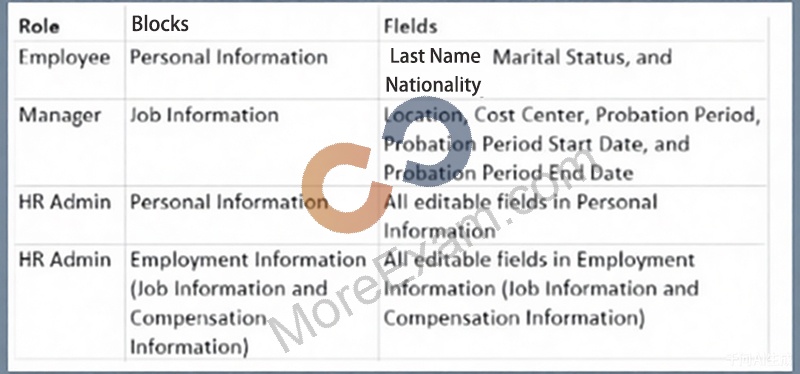
Question7: You nave a global customer who has legal entities in multiple countries The customer wants to empower employees and managers to use the system, so they have decided to implement Employee Self-Service and Manager Self-Service The customer also has payroll integration with different systems, and for some countries, the data is manually maintained in the payroll system The requirements are as follows Employees should be able to update their Personal Information, including Last Name Marital Status, and Nationality fields Managers should be able to update Job Informationon the employee's profile, butlimited only to Location.
Cost Center. Probation Period. Probation Period Start
Date: and Probation Period End Date.
Only HR admins should have access to approvethe workflows, and the managershould only get CC notifications for Personal Information (Name Marital Status,and Nationality change) For all other changes,the manager should not get anyinformation or notification HR admins should be able to change Personal information as well as Employment Information, and the HR Business Partner needs to approve these. If the HR adminneeds to change the Compensation Information approval will need to be grantedby their own managerFor one country, there needs to be another approval from the data team who willmanually maintain the payroll system The table below summarizes the permissions for each role:


Due to confidentiality reasons, when the HR Business Partner (maintained in Job Relationship) is creating a change in salary for an employee, this action will need to be approved by the manager of the HR Business Partner creating the request.How do you define this in the workflow when filling in the Approver Type, Approver Role, Context, and Relationship to Approver? Refer to the screenshot to answer the question.

Question8: In which entities is Alert Notification supported? Note: There are 2 correct answers to this question.

Question9: What actions can you initiate from the Position Org chart? Note: There are 3 correct answers to this question.

Question10: You have a global customer who has legal entities in multiple countries. The customer wants to empower employees and managers to use the system, so they have decided to implement Employee Self-Service and Manager Self-Service The customer also has payroll integration with different systems and for some countries, the data is manually maintained in the payroll system The requirements are as follows
* Employees should be able to update their Personal information, including Last Name. Mantel Status, and Nationality fields
* Managers should be able to update Job Information on the employee's profile, but limited only to Location, Cost Center, Probation Period. Probation Period Start Date and Probation Period End Date
* Only HR admins should have access to approve the workflows and the manager should only get CC notifications for Personal Information (Name Mantel Status, and Nationality change) For all other changes, the manager should not get any information or notification
* HR admins should be able to change Personal Information as well as Employment Information and the HR Business Partner needs to approve these If the HR admin needs to change the Compensation information, approval will need to be granted by their own manager
* For one country, there needs to be another approval from the data team, who will manually maintain the payroll system The table below summarizes the permissions for each role:

When the manager updates the location of an employee, the HR admin must be the approver. Note that the HR admin, manager, and HR Business Partner have access to change the location.How do you create the IF condition for the workflow derivation rule to meet the above requirements?

Question11: To which Job information field will you assign the Default_JobClass rule?

Question12: How does the system validate the destination object for composite associations?

Question13: Which steps are required to set up the Auto Delegation feature for a workflow in Employee Central? Note:
There are 2 correct answers to this question.

Question14: In which order must you assign the rules?
In which order must you assign the rules?

Question15: How do you configure alert recipients?

Question16: Which employment objects support a country-specific field configuration? Note: There are 2 correct answers to this question.

Question17: Which method of modifying employee data will trigger an event reason derivation?

Question18: What must be done to ensure that you can use a custom generic (MDF) object for Employee Self-Service?
Note: There are 2 correct answers to this question.

Question19: Your customer would like to autogenerate the Position Code to avoid manual entry. Which of the following are prerequisites to achieve this requirement? Note: There are 3 correct answers to this question.

Question20: How do you enable a cost center in the Succession Data Model to be used as a filter in a permission group?

Question21: What does it mean when a position is subjected to capacity control?

Question22: A customer has scheduled an HRIS sync job, which includes mapping of titles, to run every Friday. On Tuesday; an employee's job title is changed via Manager Self-Service (MSS) to become effective on Thursday.
When will the synchronization happen?

Question23: You have a global customer who has legal entities In multiple countries The customer wants to empower employees and managers to use the system, so they have decided to implement Employee Seif-Service and Manager Self-Service The customer also has payroll integration with different systems, and for some countries, the data is manually maintained In the payroll system The requirements are as follows
* Employees should be able to update their Personal information, including Last Name. Marital Status, and Nationality fields
* Managers should be able to update Job information on the employee's profile but limited only to Location.
Cost Center. Probation Period. Probation Period Start Date, and Probation Period End Date
* Only HR admins should have access to approve the workflows, and the manager should only get CC notifications for Personal Information (Name. Marital Status, and Nationality change) For all other changes, the manager should not get any information or notification
* HR admins should be able to change Personal Information as well as Employment information, and the HR Business Partner needs to approve these If the HR admin needs to change the Compensation Information approval will need to be granted by their own manager
* For one country, there needs to be another approval from the data team who will manually maintain the payroll system.
The table below summarizes the permissions for each role:

An employee will be changing their nationality information on their own. How do you build the IF condition in the business rule so they can do this?

Question24: Which events are NOT supported by event reason derivation? Note: There are 2 correct answers to this question.

Question25: What base object must you use for the JobInfo_FTE_Comp rule?

Question26: Your customer would like to automate its company's HR transactions. This includes auto-populating fields to reduce data entry errors and automating approvals during self-service transactions.
You are asked to create the following rules based on your customer's requirements:
* Three event reason derivation rules (ERD1, ERD2, ERD3)
* A separate catch-all event reason derivation rule (ERD-Catch)
* A workflow derivation rule based on event reasons (WFD)
* A rule to auto-populate the Job Title. Pay Grade, and Employee Class field values in the Job Information whenever the job code is changed (Defauit_JobClass)
* A rule to use AddressChange workflow for any address change requests (WFD_Address)
* A cross-entity rule to auto-calculate the Base_Salary amount based on ) changes to the FTE value for any event other than Hire or Rehire (Joblnfo_FTE_Comp) Answer the questions to ensure the event reasons and workflow rules adhere to SAP SuccessFactors recommended practices.
Which clause meets the WFD_Address rule requirement?

Question27: In your project, the client asks for a mechanism by which a workflow can be approved by any one of a pool of people. What tool would you use to configure the group?

Question28: You have a global customer who has legal entities m multiple countries The customer wants to empower employees and managers to use the system, so they have decided to implement Employee Self-Service and Manager Self-Service The customer also has payroll integration with different systems, and for some countries, the data is manually maintained in the payroll system The requirements are as follows
* Employees should be able to update their Personal Information, including Last Name. Marital Status, and Nationality fields
* Managers should be able to update Job Information on the employee's profile, but limited only to Location Cost Center, Probation Period Probation Period Start Date and Probation Period End Date
* Only HR admins should have access to approve the workflows, and the manager should only get CC notifications for Personal Information (Name. Marital Status, and Nationality change) For all other changes, the manager should not get any information or notification
* HR admins should be able to change Personal Information as well as Employment information and the HR Business Partner needs to approve these. If the HR admin needs to change the Compensation Information, approval will need to be granted by their own manager
* For one country, there needs to be another approval from the data team, who will manually maintain the payroll system The table below summarizes the permissions for each role:

How should you build the IF condition to identify the user when the employee is updating their own Personal Information?

Question29: Manager A initiated a job code change for Employee X with an effectivity date of January 15. Another manager initiated the same request, but for January 30. What happens to the workflows triggered by both transactions?

Question30: Your customer needs to set up a workflow to direct approval processes to the head of a business unit. Which approver type do you use?

Question31: What are some of the position management application-specific rule scenarios? Note: There are 3 correct answers to this question.

Question32: This is a global customer and HR admins will be assigned based on legal entity. The HR admins should be getting approval workflows from their target population. How can you define this in one workflow?

Question33: Which action will trigger a system validation for an in-progress workflow?

Question34: Your customer would like to automate its company's HR transactions. This includes auto-populating fields to reduce data entry errors and automating approvals during self-service transactions.
You are asked to create the following rules based on your customer's requirements:
* Three event reason derivation rules (ERD1. ERD2. ERD3)
* A separate catch-all event reason derivation rule (ERD-Catch)
* A workflow derivation rule based on event reasons (WFDJ
* A rule to auto-populate the Job Title, Pay Grade, and Employee Class field values in the Job Information whenever the job code is changed (Default_JobClass)
* A rule to use AddressChange workflow for any address change requests (WFD_Address)
* A cross-entity rule to auto-calculate the Base_Salary amount based on changes to the FTE value for any event other than Hire or Rehire (Jobinfo_FTE_Comp) Answer the questions to ensure the event reasons and workflow rules adhere to How do you set the event date in Compensation Information for the JobInfo_FTE_Comp cross-entity rule?

Question35: An employee is changing their Last Name, so a CC workflow notification should be sent to their manager.
When is the CC workflow notification sent out?

Question36: How is the event reason derived when a business rule is enabled for import?
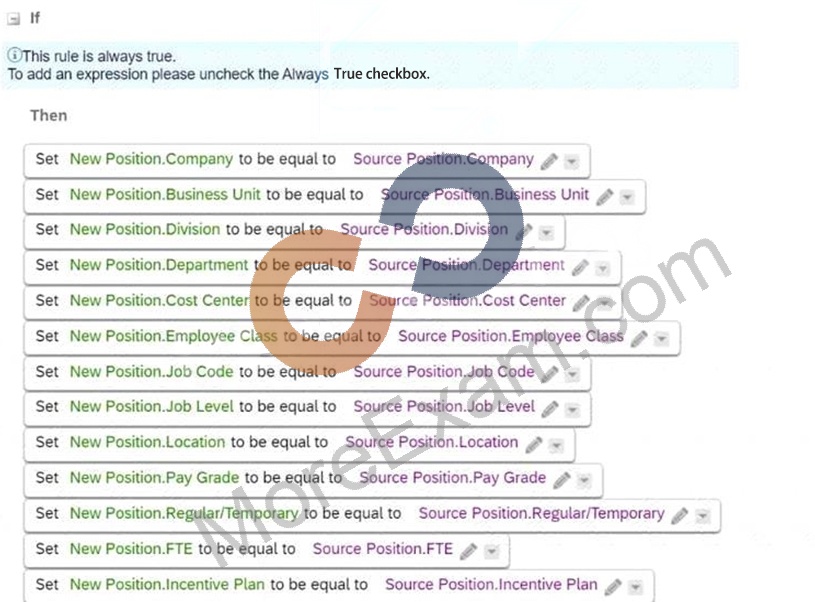
Question37: Based on the screenshot below, can you identify any errors on the definition of the business rule to Default Position Attributes?Note: There are 2 correct answers to this question.If Then