EMT Practice Test

1. Question Content...


Question List

Question1: Which of the following attributes of an investment are affected by changes in leverage:

Question2: Under the contingent claims approach to measuring credit risk, which of the following factors does NOT affect credit risk:

Question3: An operational loss severity distribution is estimated using 4 data points from a scenario. The management institutes additional controls to reduce the severity of the loss if the risk is realized, and as a result the estimated losses from a 1-in-10-year losses are halved. The 1-in-100 loss estimate however remains the same.
What would be the impact on the 99.9th percentile capital required for this risk as a result of the improvement in controls?

Question4: Which of the following describes rating transition matrices published by credit rating firms:

Question5: The CDS quote for the bonds of Bank X is 200 bps. Assuming a recovery rate of 40%, calculate the default hazard rate priced in the CDS quote.

Question6: Which of the following situations are not suitable for applying parametric VaR:
I. Where the portfolio's valuation is linearly dependent upon risk factors II. Where the portfolio consists of non-linear products such as options and large moves are involved III. Where the returns of risk factors are known to be not normally distributed

Question7: Which of the following statements is true
I. If no loss data is available, good quality scenarios can be used to model operational risk II. Scenario data can be mixed with observed loss data for modeling severity and frequency estimates III. Severity estimates should not be created by fitting models to scenario generated loss data points alone IV. Scenario assessments should only be used as modifiers to ILD or ELD severity models.

Question8: What ensures that firms are not able to selectively default on some obligations without being considered in default on the others?

Question9: A bank extends a loan of $1m to a home buyer to buy a house currently worth $1.5m, with the house serving as the collateral. The volatility of returns (assumed normally distributed) on house prices in that neighborhood is assessed at 10% annually. The expected probability of default of the home buyer is 5%.
What is the probability that the bank will recover less than the principal advanced on this loan; assuming the probability of the home buyer's default is independent of the value of the house?

Question10: The minimum 'multiplication factor' to be applied to VaR calculations for calculating the capital requirements for the trading book per Basel II is equal to:

Question11: Economic capital under the Earnings Volatility approach is calculated as:

Question12: Which of the following is a most complete measure of the liquidity gap facing a firm?


Question13: If the loss given default is denoted by L, and the recovery rate by R, then which of the following represents the relationship between loss given default and the recovery rate?

Question14: An asset has a volatility of 10% per year. An investment manager chooses to hedge it with another asset that has a volatility of 9% per year and a correlation of 0.9. Calculate the hedge ratio.

Question15: If two bonds with identical credit ratings, coupon and maturity but from different issuers trade at different spreads to treasury rates, which of the following is a possible explanation:
I. The bonds differ in liquidity
II. Events have happened that have changed investor perceptions but these are not yet reflected in the ratings III. The bonds carry different market risk IV. The bonds differ in their convexity

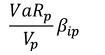
Question16: Which of the formulae below describes incremental VaR where a new position 'm' is added to the portfolio?
(where p is the portfolio, and V_i is the value of the i-th asset in the portfolio. All other notation and symbols have their usual meaning.) A)

B)

C)

D)

Question17: The returns for a stock have a monthly volatilty of 5%. Calculate the volatility of the stock over a two month period, assuming returns between months have an autocorrelation of 0.3.

Question18: What is the annualized steady state volatility under a GARCH model where alpha is 0.1, beta is 0.8 and omega is 0.00025?

Question19: Which of the following are considered properties of a 'coherent' risk measure:
I. Monotonicity
II. Homogeneity
III. Translation Invariance
IV. Sub-additivity

Question20: Fill in the blank in the following sentence:
Principal component analysis (PCA) is a statistical tool to decompose a ____________ matrix into its principal components and is useful in risk management to reduce dimensions.

Question21: As opposed to traditional accounting based measures, risk adjusted performance measures use which of the following approaches to measure performance:

Question22: If the marginal probabilities of default for a corporate bond for years 1, 2 and 3 are 2%, 3% and 4% respectively, what is the cumulative probability of default at the end of year 3?

Question23: Under the KMV Moody's approach to credit risk measurement, how is the distance to default converted to expected default frequencies?

Question24: Which of the following is not a possible early warning indicator in relation to the health of a counterparty?

Question25: Under the internal ratings based approach for risk weighted assets, for which of the following parameters must each institution make internal estimates (as opposed to relying upon values determined by a national supervisor):

Question26: A risk analyst attempting to model the tail of a loss distribution using EVT divides the available dataset into blocks of data, and picks the maximum of each block as a data point to consider.
Which approach is the risk analyst using?

Question27: The accuracy of a VaR estimate based on a Monte carlo simulation of portfolio prices is affected by:
I. The shape of the distribution of portfolio values
II. The number simulations carried out
III. The confidence level selected for the VaR estimate

Question28: Which of the following is the most important problem to solve for fitting a severity distribution for operational risk capital:

Question29: Which of the following best describes the concept of marginal VaR of an asset in a portfolio:

Question30: A bullet bond and an amortizing loan are issued at the same time with the same maturity and with the same principal. Which of these would have a greater credit exposure halfway through their life?

Question31: Which of the following statements are true:
I. Stress testing, if exhaustive, can replace traditional risk management tools such as value-at-risk (VaR) II. Stress tests can be particularly useful in identifying risks with new products III. Stress testing is distinct from a bank's ICAAP carried out periodically IV. Stress testing is a powerful communication tool that can convey risks to decisionmakers in an organization

Question32: A risk analyst peforming PCA wishes to explain 80% of the variance. The first orthogonal factor has a volatility of 100, and the second 40, and the third 30. Assume there are no other factors. Which of the factors will be included in the final analysis?

Question33: According to the Basel II standard, which of the following conditions must be satisfied before a bank can use
'mark-to-model' for securities in its trading book?
I. Marking-to-market is not possible
II. Market inputs for the model should be sourced in line with market prices III. The model should have been created by the front office IV. The model should be subject to periodic review to determine the accuracy of its performance

Question34: Which of the following are valid approaches for extreme value analysis given a dataset:
I. The Block Maxima approach
II. Least squares approach
III. Maximum likelihood approach
IV. Peak-over-thresholds approach

Question35: Altman's Z-score does not consider which of the following ratios:

Question36: Which of the following best describes economic capital?

Question37: A corporate bond maturing in 1 year yields 8.5% per year, while a similar treasury bond yields 4%. What is the probability of default for the corporate bond assuming the recovery rate is zero?

Question38: Which of the following statements is true in relation to collateral management?
I. A collateral management system need not consider the failure by counterparties to return collateral when due II. The extent to which counterparties may have rehypothecated collateral is not a consideration for a collateral management system III. Cash is an acceptable substitute for any type of collateral required to be posted IV. Haircuts do not apply to treasury issued instruments posted as collateral

Question39: Which of the following methods cannot be used to calculate Liquidity at Risk?

Question40: Which of the following statements are true:
I. Common scenarios for stress tests include the 1997 Asian crisis, the Russian default in 1998 and other well known economic stress situations.
II. Stress tests provide the assurance that an institution's worst case losses will be covered.
III. Performing stress tests is highly recommended but is not mandated under Basel II.
IV. Historical events can be modeled quite accurately as they have defined start and end dates.

Question41: Credit exposure for derivatives is measured using

Question42: Which of the following statements is true?

Question43: Which of the following are valid objectives of a reverse stress test:
I. Ensure that a firm can survive for long enough after risks have materialized for it to either regain market confidence, restructure or be sold, or be closed down in an orderly manner, II. Discover the vulnerabilities of the current business plan, III. Better integrate business and capital planning, IV. Create a 'zero-failure' environment at the systemic level in the financial sector

Question44: Which of the following represent the parameters that define a VaR estimate?

Question45: The 99% 10-day VaR for a bank is $200mm. The average VaR for the past 60 days is $250mm, and the bank specific regulatory multiplier is 3. What is the bank's basic VaR based market risk capital charge?

Question46: Which of the following statements is true in relation to a normal mixture distribution:
I. The mixture will always have a kurtosis greater than a normal distribution with the same mean and variance II. A normal mixture density function is derived by summing two or more normal distributions III. VaR estimates for normal mixtures can be calculated using a closed form analytic formula

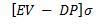
Question47: If EV be the expected value of a firm's assets in a year, and DP be the 'default point' per the KMV approach to credit risk, and be the standard deviation of future asset returns, then the distance-to-default is given by:
A)

B)

C)

D)

Question48: An assumption of normality when returns data have fat tails leads to:
I. underestimation of VaR at high confidence levels
II. overestimation of VaR at low confidence levels
III. overestimation of VaR at high confidence levels
IV. underestimation of VaR at low confidence levels

Question49: The key difference between 'top down models' and 'bottom up models' for operational risk assessment is:

Question50: For a corporate issuer, which of the following can be used to calculate market implied default probabilities?
I. CDS spreads
II. Bond prices
III. Credit rating issued by S&P
IV. Altman's scoring model

Question51: Which of the following losses can be attributed to credit risk:
I. Losses in a bond's value from a credit downgrade
II. Losses in a bond's value from an increase in bond yields
III. Losses arising from a bond issuer's default
IV. Losses from an increase in corporate bond spreads

Question52: Which of the following is not a risk faced by a bank from holding a portfolio of residential mortgages?

Question53: A bank prices retail credit loans based on median default rates. Over the long run, it can expect:

Question54: Which of the following is not a limitation of the univariate Gaussian model to capture the codependence structure between risk factros used for VaR calculations?

Question55: When compared to a high severity low frequency risk, the operational risk capital requirement for a low severity high frequency risk is likely to be:

Question56: A derivative contract has a negative current replacement value. Which of the following statements is true about its loan equivalent value for credit risk calculations over a 2-year horizon?

Question57: A bank evaluates the impact of large and severe changes in certain risk factors on its risk using a quantitative valuation model. Which of the following best describes this exercise?

Question58: As part of designing a reverse stress test, at what point should a bank's business plan be considered unviable (ie the point where it can be considered to have failed)?

Question59: Which of the following was not a policy response introduced by Basel 2.5 in response to the global financial crisis:

Question60: Which of the following statements are true?
I. Retail Risk Based Pricing involves using borrower specific data to arrive at both credit adjudication and pricing decisions II. An integrated 'Risk Information Management Environment' includes two elements - people and processes III. A Logical Data Model (LDM) lays down the relationships between data elements that an organization stores IV. Reference Data and Metadata refer to the same thing

Question61: Which of the following introduces model error when basing VaR on a normal distribution with a static mean and standard deviation?

Question62: A bank's detailed portfolio data on positions held in a particular security across the bank does not agree with the aggregate total position for that security for the bank. What data quality attribute is missing in this situation?

Question63: The risk that a counterparty fails to deliver its obligation upon settlement while having received the leg owed to it is called:

Question64: The estimate of historical VaR at 99% confidence based on a set of data with 100 observations will end up being:

Question65: Under the standardized approach to calculating operational risk capital under Basel II, negative regulatory capital charges for any of the business units:

Question66: What does a middle office do for a trading desk?

Question67: An assumption regarding the absence of ratings momentum is referred to as:

Question68: The generalized Pareto distribution, when used in the context of operational risk, is used to model:

Question69: The frequency distribution for operational risk loss events can be modeled by which of the following distributions:
I. The binomial distribution
II. The Poisson distribution
III. The negative binomial distribution
IV. The omega distribution

Question70: What is the risk horizon period used for credit risk as generally used for economic capital calculations and as required by regulation?

Question71: The definition of operational risk per Basel II includes which of the following:
I. Risk of loss resulting from inadequate or failed internal processes, people and systems or from external events II. Legal risk III. Strategic risk IV. Reputational risk

Question72: For a hypotherical UoM, the number of losses in two non-overlapping datasets is 24 and 32 respectively. The Pareto tail parameters for the two datasets calculated using the maximum likelihood estimation method are 2 and 3. What is an estimate of the tail parameter of the combined dataset?

Question73: Which of the following data sources are expected to influence operational risk capital under the AMA:
I. Internal Loss Data (ILD)
II. External Loss Data (ELD)
III. Scenario Data (SD)
IV. Business Environment and Internal Control Factors (BEICF)

Question74: Which of the following statements is true:
I. Recovery rate assumptions can be easily made fairly accurately given past data available from credit rating agencies.
II. Recovery rate assumptions are difficult to make given the effect of the business cycle, nature of the industry and multiple other factors difficult to model.
III. The standard deviation of observed recovery rates is generally very high, making any estimate likely to differ significantly from realized recovery rates.
IV. Estimation errors for recovery rates are not a concern as they are not directionally biased and will cancel each other out over time.

Question75: If the duration of a bond yielding 10% is 6 years, the volatility of the underlying interest rates 5% per annum, what is the 10-day VaR at 99% confidence of a bond position comprising just this bond with a value of $10m?
Assume there are 250 days in a year.

Question76: Which of the following statements is true in respect of different approaches to calculating VaR?
I. Linear or parametric VaR does not take correlations into account
II. For large portfolios with little or no optionality or other non-linear attributes, parametric VaR is an efficient approach to calculating VaR III. For large portfolios with complex sources of risk and embedded optionalities, the full revaluation method of calculating VaR should be preferred IV. Delta normal local revaluation based VaR is suitable for fixed income and option portfolios only

Question77: Conditional default probabilities modeled under CreditPortfolio view use a:

Question78: Which of the following statements is true?
I. Real Time Gross Systems (RTGS) for large value payments consume less system liquidity than Deferred Net Systems (DNS) II. The US Fedwire is an example of a Real Time Gross System III. Current disclosure requirements in relation to liquidity risk as laid down in the Basel framework require banks to disclose how liquidity stress scenarios were formulated IV. A CFP (Contingency Funding Plan) provides access to Central Bank financing

Question79: When performing portfolio stress tests using hypothetical scenarios, which of the following is not generally a challenge for the risk manager?

Question80: Which of the following is NOT true in respect of bilateral close out netting:

Question81: When doing stress tests based on historical scenarios, if no appropriate historical scenarios exist for a security, it is most INAPPROPRIATE to:

Question82: Which of the following statements is correct in relation to liquidity risk management?
I. Pricing for products that do not impact the balance sheet need not reflect the cost of maintaining liquidity II. Time horizons for liquidity risk management are impacted by both regulatory requirements and the speed at which new sources of liquidity can be tapped III. Collateral management is an important aspect of liquidity risk management IV. The maturity period of various instruments in the capital structure has a significant impact on liquidity needs

Question83: Which loss event type is the failure to timely deliver collateral classified as under the Basel II framework?

Question84: Which of the following credit risk models includes a consideration of macro economic variables such as unemployment, balance of payments etc to assess credit risk?

Question85: Which of the following is the most accurate description of EPE (Expected Positive Exposure):

Question86: Which of the following statements is true in respect of a non financial manufacturing firm?
I. Market risk is not relevant to the manufacturing firm as it does not take proprietary positions II. The firm faces market risks as an externality which it must bear and has no control over III. Market risks can make a comparative assessment of profitability over time difficult IV. Market risks for a manufacturing firm are not directionally biased and do not increase the overall risk of the firm as they net to zero over a long term time horizon

Question87: When building a operational loss distribution by combining a loss frequency distribution and a loss severity distribution, it is assumed that:
I. The severity of losses is conditional upon the number of loss events II. The frequency of losses is independent from the severity of the losses III. Both the frequency and severity of loss events are dependent upon the state of internal controls in the bank

Question88: A portfolio's 1-day VaR at the 99% confidence level is $250m. What is the annual volatility of the portfolio?
(assuming 250 days in the year)

Question89: Which of the following statements is true:
I. Confidence levels for economic capital calculations are driven by desired credit ratings II. Loss distributions for operational risk are affected more by the severity distribution than the frequency distribution III. The Advanced Measurement Approach (AMA) referred to in the Basel II standard is a type of a Loss Distribution Approach (LDA) IV. The loss distribution for operational risk under the LDA (Loss Distribution Approach) is estimated by separately estimating the frequency and severity distributions.

Question90: Which of the following is not one of the 'three pillars' specified in the Basel accord:

Question91: Which of the following statements are true in relation to Historical Simulation VaR?
I. Historical Simulation VaR assumes returns are normally distributed but have fat tails II. It uses full revaluation, as opposed to delta or delta-gamma approximations III. A correlation matrix is constructed using historical scenarios IV. It particularly suits new products that may not have a long time series of historical data available

Question92: In respect of operational risk capital calculations, the Basel II accord recommends a confidence level and time horizon of:

Question93: According to the Basel framework, reserves resulting from the upward revaluation of assets are considered a part of:

Question94: Which of the following assumptions underlie the 'square root of time' rule used for computing VaR estimates over different time horizons?
I. the portfolio is static from day to day
II. asset returns are independent and identically distributed (i.i.d.)
III. volatility is constant over time
IV. no serial correlation in the forward projection of volatility
V. negative serial correlations exist in the time series of returns
VI. returns data display volatility clustering

Question95: Which of the following are valid methods for selecting an appropriate model from the model space for severity estimation:
I. Cross-validation method
II. Bootstrap method
III. Complexity penalty method
IV. Maximum likelihood estimation method

Question96: The capital adequacy ratio applied to risk weighted assets for the calculation of capital requirements for credit risk per Basel II is:

Question97: If F be the face value of a firm's debt, V the value of its assets and E the market value of equity, then according to the option pricing approach a default on debt occurs when:

Question98: Which of the following is a valid approach to determining the magnitude of a shock for a given risk factor as part of a historical stress testing exercise?
I. Determine the maximum peak-to-trough change in the risk factor over the defined period of the historical event II. Determine the minimum peak-to-trough change in the risk factor over the defined period of the historical event III. Determine the total change in the risk factor between the start date and the finish date of the event regardless of peaks and troughs in between IV. Determine the maximum single day change in the risk factor and multiply by the number of days covered by the stress event

Question99: Which of the following is not an approach used for stress testing:

Question100: Which of the following formulae describes Marginal VaR for a portfolio p, where V_i is the value of the i-th asset in the portfolio? (All other notation and symbols have their usual meaning.) A)

B)

C)

D)
All of the above

Question101: Which of the following statements are true:
I. Pre-settlement risk is the risk that one of the parties to a contract might default prior to the maturity date or expiry of the contract.
II. Pre-settlement risk can be partly mitigated by providing for early settlement in the agreements between the counterparties.
III. The current exposure from an OTC derivatives contract is equivalent to its current replacement value.
IV. Loan equivalent exposures are calculated even for exposures that are not loans as a practical matter for calculating credit risk exposure.

Question102: Which of the following are elements of 'group risk':
I. Market risk
II. Intra-group exposures
III. Reputational contagion
IV. Complex group structures

Question103: Under the credit migration approach to assessing portfolio credit risk, which of the following are needed to generate a distribution of future portfolio values?

Question104: For an equity portfolio valued at V whose beta is , the value at risk at a 99% level of confidence is represented by which of the following expressions? Assume represents the market volatility.

Question105: The results of 'desk-level' stress tests cannot be added together to arrive at institution wide estimates because:

Question106: The systemic manifestation of the liquidity crisis during the current credit crisis took many forms. Which of the following is not one of those forms?

Question107: Which of the following statements is true:

Question108: For a group of assets known to be positively correlated, what is the impact on economic capital calculations if we assume the assets to be independent (or uncorrelated)?

Question109: Which of the following cannot be used to address the issue of heavy tails when modeling market returns

Question110: Which of the following contributed to the systemic failure during the credit crisis that began in 2007?

Question111: Which of the following statements are true:
I. The sum of unexpected losses for individual loans in a portfolio is equal to the total unexpected loss for the portfolio.
II. The sum of unexpected losses for individual loans in a portfolio is less than the total unexpected loss for the portfolio.
III. The sum of unexpected losses for individual loans in a portfolio is greater than the total unexpected loss for the portfolio.
IV. The unexpected loss for the portfolio is driven by the unexpected losses of the individual loans in the portfolio and the default correlation between these loans.

Question112: Which of the following is true in relation to a Contingency Funding Plan (CFP)?
I. A CFP is like a disaster recovery plan to deal with a liquidity crisis II. A CFP should consider market stress conditions, but failures of payment systems are not relevant as they fall under the remit of operational risk III. Reputational damage may result if the market finds out that a firm has had to execute its CFP IV. Sources of emergency funding considered in the CFP should include the role of the central bank as the lender of last resort

Question113: Which of the following statements is true?
I. It is sufficient to ensure that a parent entity has sufficient excess liquidity to cover a liquidity shortfall for a subsidiary.
II. If a parent entity has a shortfall of liquidity, it can always rely upon any excess liquidity that its foreign subsidiaries might have.
III. Wholesale funding sources for a bank refer to stable sources of funding provided by the central bank.
IV. Funding diversification refers to diversification of both funding sources and funding tenors.

Question114: If the annual default hazard rate for a borrower is 10%, what is the probability that there is no default at the end of 5 years?

Question115: If the systematic VaR for an equity portfolio is $100 and the specific VaR is $80, then which of the following is true in relation to the total VaR:

Question116: Which of the following are measures of liquidity risk
I. Liquidity Coverage Ratio
II. Net Stable Funding Ratio
III. Book Value to Share Price
IV. Earnings Per Share

Question117: If the odds of default are 1:5, what is the probability of default?

Question118: What is the combined VaR of two securities that are perfectly positively correlated.

Question119: long bond position is hedged using a short position in the futures market. If the hedge performs as expected, then which of the following statements is most accurate:

Question120: The degree distribution of the nodes of the financial network is:

Question121: Which of the following risks and reasons justify the use of scenario analysis in operational risk modeling:
I. Risks for which no internal loss data is available
II. Risks that are foreseeable but have no precedent, internally or externally III. Risks for which objective assessments can be made by experts IV. Risks that are known to exist, but for which no reliable external or internal losses can be analyzed
V. Reducing the complexity of having to fit statistical models to internal and external loss data VI. Managing the capital estimation process as to produce estimates in line with management's desired capital buffers.

Question122: Calculate the 1-year 99% credit VaR of a portfolio of two bonds, each with a value of $1m, and the probability of default of 1% each over the next year. Assume the recovery rate to be zero, and the defaults of the two bonds to be uncorrelated to each other.

Question123: For a security with a daily standard deviation of 2%, calculate the 10-day VaR at the 95% confidence level.
Assume expected daily returns to be nil.

Question124: If the full notional value of a debt portfolio is $100m, its expected value in a year is $85m, and the worst value of the portfolio in one year's time at 99% confidence level is $60m, then what is the credit VaR?

Question125: CreditRisk+, the actuarial model for calculating portfolio credit risk, is based upon: