EMT Practice Test

1. Question Content...


Question List

Question1: The audit lifecycle describes the ISO 19011 process for conducting an individual audit. Drag and drop the steps of the audit lifecycle into the correct sequence.

Question2: The following options are key actions involved in a first-party audit. Order the stages to show the sequence in which the actions should take place.

Question3: Please match the following situations to the type of audit required.
Question4: You are an experienced ISMS audit team leader providing guidance to an auditor in training. She asks you why it is important to have specific criteria relating to the grading of nonconformities.
Which one of the following responses is correct?

Question5: You have a hard copy of a customer design document that you want to dispose off. What would you do

Question6: You are an experienced ISMS audit team leader, talking to an Auditor in training who has been assigned to your audit team. You want to ensure that they understand the importance of the Check stage of the Plan-Do-Check-Act cycle in respect of the operation of the information security management system.
You do this by asking him to select the words that best complete the sentence:
To complete the sentence with the best word(s), click on the blank section you want to complete so that it is highlighted in red, and then click on the applicable text from the options below. Alternatively, you may drag and drop the option to the appropriate blank section.

Question7: Which one of the following options describes the main purpose of a Stage 1 audit?

Question8: Select the word that best completes the sentence:

Question9: You are performing an ISMS audit at a residential nursing home (ABC) that provides healthcare services. The next step in your audit plan is to verify the information security of ABC's healthcare mobile app development, support, and lifecycle process. During the audit, you learned the organization outsourced the mobile app development to a professional software development company with CMMI Level 5, ITSM (ISO/IEC 20000-1), BCMS (ISO
22301) and
ISMS (ISO/IEC 27001) certified.
The IT Manager presented the software security management procedure and summarised the process as following:
The mobile app development shall adopt "security-by-design" and "security-by-default" principles, as a minimum.
The following security functions for personal data protection shall be available:
Access control.
Personal data encryption, i.e., Advanced Encryption Standard (AES) algorithm, key lengths: 256 bits; and Personal data pseudonymization.
Vulnerability checked and no security backdoor
You sample the latest Mobile App Test report, details as follows:

The IT Manager explains the test results should be approved by him according to the software security management procedure. The reason why the encryption and pseudonymisation functions failed is that these functions heavily slowed down the system and service performance. An extra 150% of resources are needed to cover this. The Service Manager agreed that access control is good enough and acceptable. That's why the Service Manager signed the approval.
You are preparing the audit findings. Select the correct option.

Question10: What is the difference between a restricted and confidential document?

Question11: Select the words that best complete the sentence:
To complete the sentence with the word(s) click on the blank section you want to complete so that it is highlighted in red, and then click on the application text from the options below. Alternatively, you may drag and drop the option to the appropriate blank section.

Question12: Which two of the following statements are true?

Question13: Who are allowed to access highly confidential files?
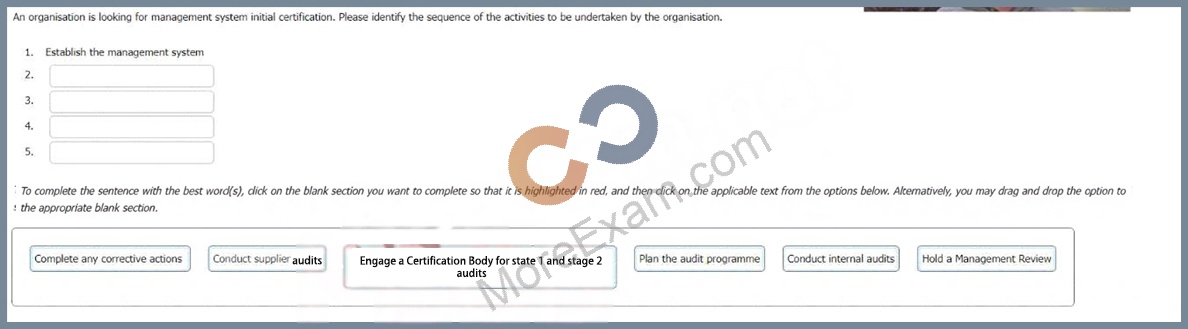
Question14: An organisation is looking for management system initial certification. Please identify the sequence of the activities to be undertaken by the organisation.
To complete the sequence click on the blank section you want to complete so that it is highlighted in red, and then click on the applicable text from the options below. Alternatively, you may drag and drop the options to the appropriate blank section.

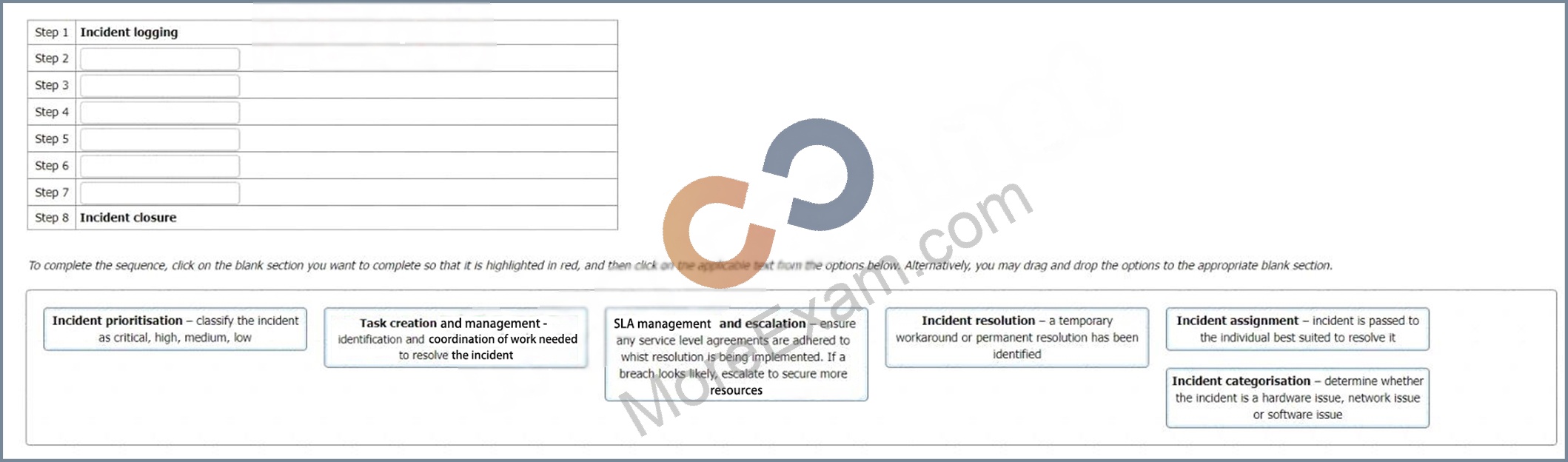
Question15: Your organisation is currently seeking ISO/IEC27001:2022 certification. You have just qualified as an Internal ISMS auditor and the ICT Manager wants to use your newly acquired knowledge to assist him with the design of an information security incident management process.
He identifies the following stages in his planned process and asks you to confirm which order they should appear in.

Question16: In the event of an Information security incident, system users' roles and responsibilities are to be observed, except:

Question17: What is we do in ACT - From PDCA cycle

Question18: Select the words that best complete the sentence below to describe a third-party audit plan.
To complete the sentence with the best word(s), click on the blank section you want to complete so that it is highlighted in red, and then click on the applicable text from the options below. Alternatively, you may drag and drop the option to the appropriate blank section.

Question19: In acceptable use of Information Assets, which is the best practice?

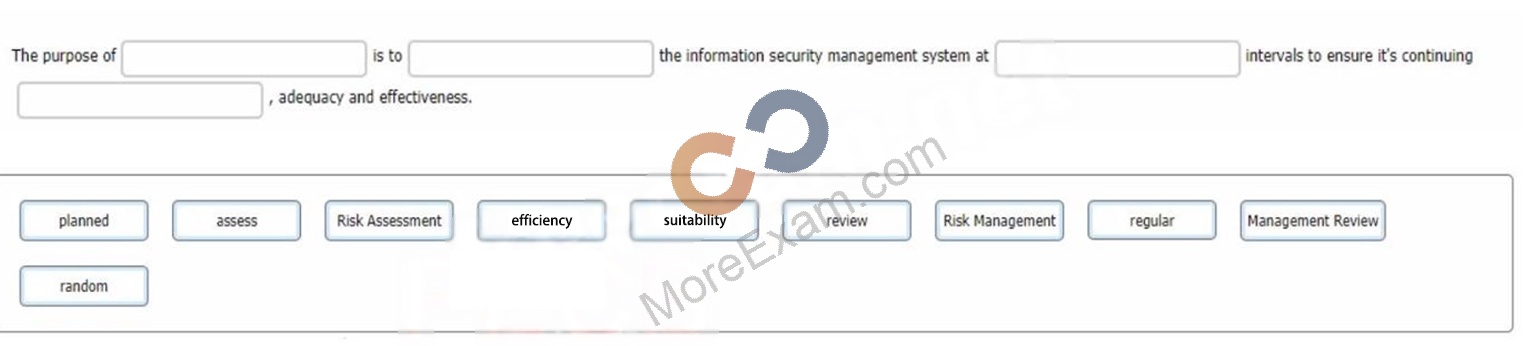
Question20: Select the words that best complete the sentence:
To complete the sentence with the best word(s), click on the blank section you want to complete so that it is highlighted in red, and then click on the applicable text from the options below. Alternatively, you may drag and drop the option to the appropriate blank section.

Question21: Match the correct responsibility with each participant of a second-party audit:

Question22: Which one of the following statements best describes the purpose of conducting a document review?

Question23: Which of the following is not a type of Information Security attack?

Question24: Please match the roles to the following descriptions:

To complete the table click on the blank section you want to complete so that it is highlighted in red, and then click on the applicable test from the options below. Alternatively, you may drag and drop each option to the appropriate blank section.

Question25: Select the words that best complete the sentence:

Question26: You are performing an ISMS audit at a residential nursing home (ABC) that provides healthcare services. The next step in your audit plan is to verify the information security of ABC's healthcare mobile app development, support, and lifecycle process. During the audit, you learned the organization outsourced the mobile app development to a professional software development company with CMMI Level 5, ITSM (ISO/IEC
20000-1), BCMS (ISO 22301) and ISMS (ISO/IEC 27001) certified.
The IT Manager presented the software security management procedure and summarised the process as following:
The mobile app development shall adopt "security-by-design" and "security-by-default" principles, as a minimum. The following security functions for personal data protection shall be available:
Access control.
Personal data encryption, i.e., Advanced Encryption Standard (AES) algorithm, key lengths: 256 bits; and Personal data pseudonymization.
Vulnerability checked and no security backdoor
You sample the latest Mobile App Test report, details as follows:

You ask the IT Manager why the organisation still uses the mobile app while personal data encryption and pseudonymization tests failed. Also, whether the Service Manager is authorised to approve the test.
The IT Manager explains the test results should be approved by him according to the software security management procedure.
The reason why the encryption and pseudonymisation functions failed is that these functions heavily slowed down the system and service performance. An extra 150% of resources are needed to cover this. The Service Manager agreed that access control is good enough and acceptable. That's why the Service Manager signed the approval.
You are preparing the audit findings. Select the correct option.

Question27: CMM stands for?

Question28: The following are purposes of Information Security, except:

Question29: You have just completed a scheduled information security audit of your organisation when the IT Manager approaches you and asks for your assistance in the revision of the company's risk management process.
He is attempting to update the current documentation to make it easier for other managers to understand, however, it is clear from your discussion he is confusing several key terms.
You ask him to match each of the descriptions with the appropriate risk term. What should the correct answers be?

Question30: During discussions with the individual(s) managing the audit programme of a certification body, the Management System Representative of the client organisation asks for a specific auditor for the certification audit. Select two of the following options for how the individual(s) managing the audit programme should respond.

Question31: Which one of the following options is the definition of the context of an organisation?

Question32: Which of the following is not a type of Information Security attack?